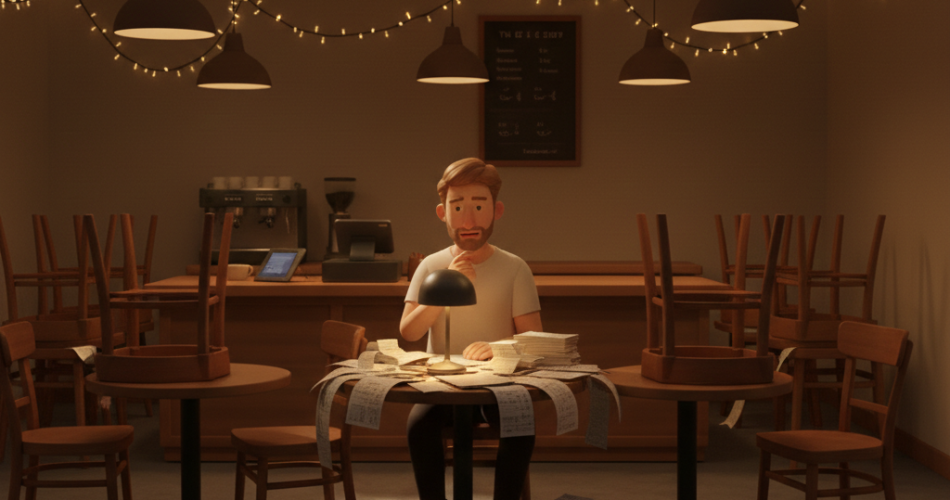
Why so many restaurants fail because they choose the wrong one
There is an uncomfortable truth in the F&B industry that beginners rarely want to hear.
Many restaurants do not close because their food is bad.
They do not even fail because they lack customers.
They fail while still selling.
While still being busy every day.
While still trying their best.
But the more they operate, the more exhausted they become.
Sales keep coming in, yet profits never seem to stay.
And one day, they simply run out of energy to keep going.
Very often, the root cause lies in something rarely discussed clearly enough:
the F&B business model.
What is an F&B business model?
When people first open a restaurant or café, they usually think the business model means the concept, the interior style, or what food they are going to sell.
In reality, an F&B business model goes much deeper than what customers can see.
It defines how your business survives on a daily basis.
How money flows in and out.
How many customers you need each day just to break even.
How many staff members are required to keep the operation running.
And most importantly, whether the owner can step away — or is permanently trapped inside the business.
If a restaurant were a living body, the business model would be its skeleton and bloodstream.
You can decorate the outside beautifully, but if the structure is wrong, collapse is only a matter of time.
Common F&B models that everyone talks about
In the F&B world, certain models sound very familiar.
Full-service restaurants, traditional eateries, cafés where customers sit for hours.
Then there are fast-service concepts, takeaway shops, delivery-focused kitchens, and cloud kitchens without dine-in spaces.
Each of these models exists for a reason.
None of them is inherently good or bad.
And none of them guarantees profit on its own.
The real question is not whether the model is trendy or popular.
The question is whether it fits the person running it.
Why do so many F&B businesses fail because of the wrong model?
Many restaurants start from pure inspiration.
The owner sees another busy place.
A concept looks exciting.
A trend feels promising.
At the beginning, everything feels full of energy.
But F&B does not run on inspiration alone.
Every single day comes with rent, salaries, ingredients, waste, and unexpected costs.
If the business model is not built to carry those expenses, the pressure builds very fast.
Some owners start with limited capital but choose models with heavy fixed costs.
Just a few months of underperforming sales can choke the cash flow completely.
Before any optimization happens, the money is already gone.
Others choose models that demand too much operational complexity.
Too many staff, too many processes, too many details to control.
Eventually, the owner becomes the hardest-working employee, present all day, every day — and the most exhausted one.

The most painful case is when a restaurant has revenue.
Customers keep coming.
The place stays busy.
Yet at the end of the month, profits are almost nonexistent.
At that point, the problem is not marketing or food quality.
The problem is structural — the business model itself.